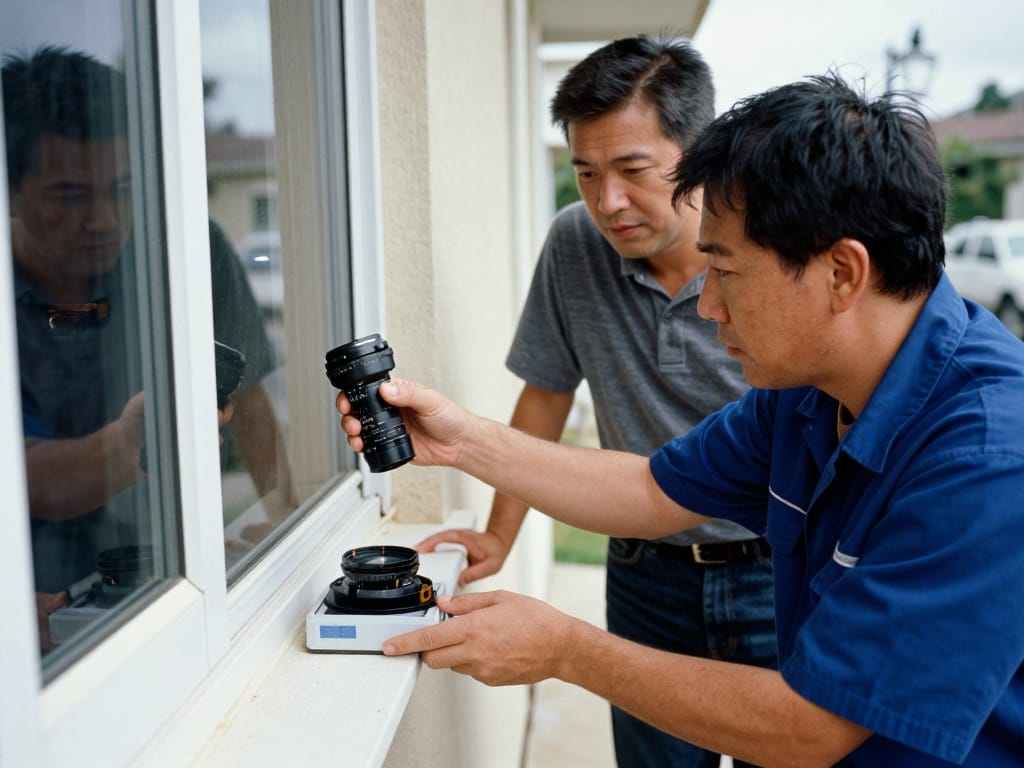
Why find air leaks in installed windows? Comfort and savings. Drafty windows make people uncomfortable, which leads to complaints and lower productivity. Air leaks also increase heating and cooling costs, especially in large buildings.
Check for leaks after window replacement or renovation. Our notes on wood window installation for homeowners who want a clean, airtight finish.. Also, check seasonally, before winter and summer. Older buildings leak more as seals break down.
How do you find leaks? Your hand works well. On a cold or hot day, move your hand around the window frame. You might feel a draft. For more precision, use an incense stick or smoke pencil. The smoke shows where the air moves. A thermal camera shows temperature differences, but it's only needed for major problems.
Common mistakes? Ignoring small drafts because they seem minor. Small leaks add up. Also, not checking the entire window frame, including the sill and wall joint.
What if you don't fix leaks? Higher energy costs, uneven temperatures, and possible moisture damage that causes mold. Mold is bad. You'll pay for it through bills, health, or repairs.
Acoustic glazing performance characteristics

Convection (or convective warmth transfer) is the transfer of warmth from one area to an additional due to the activity of liquid. Although typically discussed as a distinctive technique of heat transfer, convective warm transfer includes the mixed procedures of transmission (warmth diffusion) and advection (warmth transfer by bulk liquid circulation). Convection is normally the leading type of warmth transfer in liquids and gases. Note that this interpretation of convection is only applicable in Warmth transfer and thermodynamic contexts. It must not be puzzled with the dynamic liquid phenomenon of convection, which is usually referred to as Natural Convection in thermodynamic contexts in order to distinguish the two.
.In engineering, a mechanism is a gadget that transforms input pressures and motion right into a desired collection of outcome forces and activity. Devices normally include moving elements which might consist of gears and gear trains; Belts and chain drives; webcams and fans; Links; Friction gadgets, such as brakes or clutches; Architectural components such as a framework, fasteners, bearings, springs, or lubricating substances; Different machine components, such as splines, pins, or tricks. German researcher Franz Reuleaux specifies machine as "a mix of immune bodies so organized that by their ways the mechanical forces of nature can be compelled to do work come with by particular determinate motion". In this context, his use equipment is normally interpreted to mean mechanism. The mix of pressure and motion specifies power, and a system handles power to achieve a preferred collection of pressures and movement. A mechanism is usually an item of a bigger process, called a mechanical system or maker. In some cases a whole maker may be referred to as a system; instances are the steering device in a cars and truck, or the winding device of a watch. Nonetheless, typically, a set of multiple systems is called an equipment.
.Warm transfer is a self-control of thermal design that worries the generation, use, conversion, and exchange of thermal power (warm) in between physical systems. Warmth transfer is classified right into numerous systems, such as thermal conduction, thermal convection, thermal radiation, and transfer of power by phase modifications. Designers likewise think about the transfer of mass of differing chemical species (mass transfer in the kind of advection), either cold or hot, to attain heat transfer. While these devices have unique features, they frequently take place at the same time in the very same system. Warm transmission, additionally called diffusion, is the straight tiny exchanges of kinetic energy of bits (such as particles) or quasiparticles (such as latticework waves) via the limit between two systems. When a things goes to a different temperature from another body or its surroundings, heat streams to make sure that the body and the environments reach the exact same temperature, whereupon they are in thermal balance. Such spontaneous warmth transfer always happens from an area of heat to another area of reduced temperature level, as explained in the 2nd law of thermodynamics. Warm convection takes place when the bulk flow of a fluid (gas or fluid) brings its warmth through the liquid. All convective procedures additionally relocate heat partially by diffusion, too. The circulation of liquid may be forced by outside processes, or in some cases (in gravitational areas) by buoyancy pressures caused when thermal power broadens the liquid (for example in a fire plume), thus affecting its very own transfer. The latter procedure is frequently called "natural convection". The previous process is often called "required convection." In this instance, the fluid is compelled to flow by use of a pump, follower, or other mechanical ways. Radiant heat occurs with a vacuum cleaner or any clear tool (solid or liquid or gas). It is the transfer of energy through photons or electro-magnetic waves controlled by the same regulations.
.